LifePractice PBL
Let's connect!
  • Welcome
    • About Us
    • LP Philosophy
  • Tips & Solutions
  • The Book!
  • PBL Recipe Cards
    • An Overview
    • Sample PBL Cards
  • Learn PBL!
    • Hire us to come to your school
    • Licensed trainers only
  • Let's Talk

February 26th, 2013

2/1/2013

0 Comments

 
Picture
My PBL partner, Kevin Honeycutt and I are frequently asked questions like, “Do you know anything about PBL for (insert curriculum topic here).”
Usually the topic is something like “Financial Wellness for New Mothers” or “Religion of the 18th Century” or “Spanish for the Deaf” or “Advanced Mathematics for Budding Actuaries.” Really, it doesn’t matter the title of the class. What’s happening is that the school leader is struggling to help a teacher in a specialty area feel included in shifting education from something being done to kids to something that the kids are doing. And they see that PBL has helped in other classes. They’re really saying, “Can you help by giving this teacher resources that are specific to her area?”

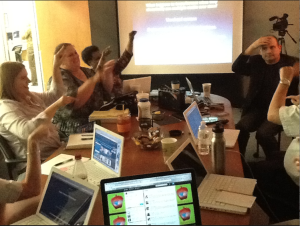
Kevin and me, working with a great group of teachers in Texas.

The answer for this is yes, we can help that teacher with Project Based Learning, if that teacher is willing to work alongside sharing his/her content knowledge to build projects. But if that teacher is looking for a set of scripted lesson plans s/he can buy off the shelf and just “follow” for his/her specialty class…well, we’re probably not going to be able to help with that.

Because you see, Project/Problem Based Learning isn’t about a set of “wash n wear” lesson plans. It’s about engaging kids with the topic — whatever topic it is — in very active ways. If a teacher understands PBL, then any known academic content can be integrated. If you want to help that specialized teacher find lesson for that specialized content area, then allow him/her to learn the basics of PBL and s/he’ll be able to build the PBL for that specialized space.

So what about our LifePractice PBL recipe cards? Aren’t those lesson plans?

Actually, no. If you check them out closely, they’re not scripted lessons; instead they provide ideas and seeds for the toughest parts of PBL: driving questions, integrating, creative product, and creative grouping. They are not about someone who has never had any PBL training picking them up and using them like a traditional lesson plan. Like anyone picking up a recipe card for the first time, we still have to have the basics of cooking in our tool belts. And so would any teacher using our LifePractice PBL recipe cards need some initial training and practice in PBL. They don’t have to be experts to use them, but they do need some training.

If you’re a school leader who’d like to implement PBL in your schools, we’ll be there 100% for you and your teachers, providing engaged training to help all of your teachers partner their content knowledge with the tenets of PBL. If you want that specialty teacher to have assistance in moving her classroom toward a PBL approach, the first place to start is with high-quality learning for her.

Contact us for more information.

Picture
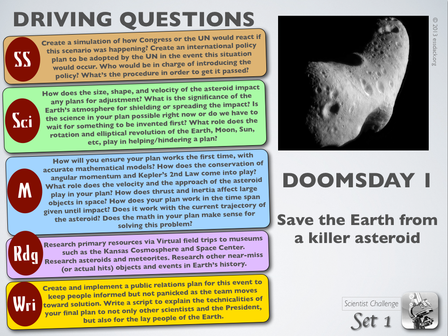
Doomsday 1 LifePracitce PBL recipe card
0 Comments

Learning by Doing, or "Defining the Not-So-Obvious"

12/30/2011

0 Comments

 
Just thinking aloud here...

If someone asked me what learning by doing means, I might stammer out a very long, and very wordy explanation, which is never a good start for me. I'd probably say something intellectually stunning like, "Well, learning by doing is when you learn <pause> while you're actually doing something."   

                                                Yep. Ginger E. Coyote, genius. 

My sad “definition” would break every single rule for how to define words and terms. So sorry Mrs. Fredrickson. 

So how would I define learning by doing?  ...that is, if I gave it a little more thought?

I think maybe we have to define what the phrase is trying to differentiate itself from. How is learning by doing different from what we traditionally know as “learning”? 

     Learning by doing is less... ?
     Learning by doing is more... ?

  • less passive and more active   
  • less paperwork and more creative work    
  • less teacher-directed and more student-directed
  • less "student" and more "learner"
  • less "memorize it and forget it" cycle and more "love it, learn it, live it" cycle  or it could be "live it, learn it, love it" cycle. Sometimes we don't know that we love something til we learn more about it.
What else?

My Plurk friend Laura Sheely suggested more global connections and more discussion, while another Plurk friend, Mark Hall, suggested more relevancy and less “busy.” 

I agree whole heartedly with both of those. 

But I also believe that many educators think they might know what the term, "learning by doing" means. I mean, aren't those 3 little words obvious?  Maybe not. As we examine it more closely to mine for a diamond-value definition, it takes on an entirely different complexity. 
Learning by doing.

What else? 

How would you define learning by doing to someone who has not even considered this concept, or to someone who might think s/he knows what it is, since the phrase is so (deceptively) simple. 


cross-posted at GingerLewman.org
0 Comments

There are ‘Knowledge Warriors’ Among Us

12/16/2011

0 Comments

 
In my years of creating a successful PBL environment from scratch at Turning Point Learning Center, I made nearly every mistake and experienced nearly every hurdle known in the world of education. If, by posting this, I can help teachers new to the PBL world to know that they’re not alone, that these are common struggles, that there are tips and solutions for the struggles, then I’ll continue to post...post...post away. 


It is not easy to start a PBL classroom, and if someone has told you that it is, you might consider not listening to that person again. 

First, teachers have to unlearn all the old ways we were taught to be a "good" teacher, and the decades of experience we had as students. We have to begin to teach to all students, pushing each to work and learn as deeply as they can go; not simply aim and talk toward the middle range of kids, hoping the slower will catch up, that the faster will be patient, and that the disengaged will stop being lazy. That's simply not good enough in a PBL classroom. 

Secondly, we have to forgive ourselves when we make mistakes. That’s no easy task for teachers when we've been told so long that mistakes = bad learning and bad teaching. After making a mistake, it’s terribly difficult to forgive ourselves, because our failures are irradiated under the white-hot spotlight of someone doing something different while surrounded by over a century of tradition. Of “teacher knows best.” 

Lastly, there is another battle that is much more hard-won, often more personal and even bloody. That’s the battle with colleagues  who feel that, by doing something different, you're attacking their professional dispositions. You can add administrators as the cavalry in the battle, who may not understand that your classroom looks different, sounds different, is different than the other classrooms across the hallway. And rounding out the blood-soaked battlefield, a teacher also faces parents who are focused so much on grades, test scores, GPA, and college entrance exams, even for their 4th graders. 

These colleagues, administrators, and parents aren't yet believers of what PBL can do for their children and in the midst of change, when a teacher who is trying hard to fight her own dragons, reaches out for help to her children’s closest allies, she may find herself facing opponents instead. They don’t intend to be but can’t help themselves. One friendly face of a colleague, a supportive word from a parent, or a comforting shield from an administrator can make all the difference in the world for the battle-scarred warrior teacher.

Jumping the PBL Implementation Hurdle: Supporting the Efforts of K–12 Teachers

The above research article from Peggy A. Ertmer and Krista D. Simon in the Interdisciplinary Journal of Problem-based Learning at Purdue University talks plainly about the challenges ahead for those teachers who believe in the real-life skills-building, authentic engagement, and a deeper understanding of content that PBL brings to our children today.

Keep your chins up, you educators, you knowledge warriors marching through the PBL crusade that is filled with brambles and snares. Look sharp, but know you are doing the RIGHT thing for yourself and for your children.  

Cross-posted at GingerLewman.org

0 Comments

Reality Check, Please!

11/29/2011

0 Comments

 
cross posted from www.GingerLewman.org 

Often, teachers think they’re ready for the realities of a “learning by doing” environment, when in fact, they’re only slightly willing to let go of the belief that “teacher knows best.” In reality, Project/Problem Based learning has many flavors, but the constant is that it requires an active, responsive mindset of all learners in a dynamic learning environment. And the teacher had better be the lead learner, willing to share teaching duties with his/her fellow learners. 

Sure, that may sound like some mumbo-jumbo, but a teacher who looks at him/herself as THE expert in the room, above the learners dooms the entire class to micro-managed misery.

Likewise, the teacher who looks only within the four walls of his/her classroom as the learning environment is short-sighted and sorry. The world is so full of readily-accessible information now, we deprive our students of rich, authentic experiences when we stick only to the mapped curriculum.


Today, we’re going to do an informal self-check to see what your comfort zone is for implementing Project/Problem Based Learning in your classroom.

On a scale of 1 - 10 (it doesn't really matter which end is which, does it? We're not keeping score), how comfortable are you…


…with differentiating content (what kids are learning), process(what they're doing to learn it), and product (what they turn in to you) for students on a daily basis?


…managing with one teacher who is working with multiple groups in a room at a time, each group doing something different?


…with not all students learning the same content in every single project?


…with some noise and mess in your room?


…with your students working with potentially dangerous tools and or messy supplies, such as hot glue guns, hammers, nails, screws, paint?


…with NOT covering every content standard in the book?


…with students who are more expert than you are in your content area?


…with supporting other adults in *your* room?


…putting in 12 hour days?


…not knowing with 100% accuracy where a project will take your students in their learning?


…with helping students resolve their own group conflicts, even though it takes more time than you thought it would?


…with not using multiple choice tests and quizzes for your gradebook?


…asking students to help you create scoring rubrics?


…teaching students how to self-assess, peer-assess, and self-reflect as a real and meaningful process of evaluation?


…with supporting your students blogging, video conferencing with experts, creating wikis, GoogleDocs, FaceBook pages, Edmodo groups, Prezis, SketchUp 3D models, video games?


…finding additional resources (experts, technology, supplies) beyond your school for (and with) your students?


…going to bat against tech dept and/or your Admin in order for your students to be allowed to access websites and other tech tools?


…with other teachers questioning your content and approach to learning because the kids are too loud, or are having too much fun to be *truly* learning?


…your own abilities to do the right thing for kids to the absolute best of your abilities at all times of the day and night? 


If you read through those questions just like a list, go back through and pause after each one. Go ahead. Time is flexible in our world of learning. 

Think about which ones you truly embrace and which ones make you wonder. Which ones make you nervous? Why? 

Please consider leaving a few thoughts about one (or more) of the realities. Where are you on this list? 

PBL teachers, which realities have I forgotten to add?

0 Comments

Bringing the Outside In: experts in your classroom

10/12/2011

1 Comment

 
cross-posted from www.GingerLewman.com

The students in grades 5-8 gathered in the lunchroom as the teacher tested the Skype connection with Christopher Orwoll, the CEO of theKansas Cosmosphere and Space Center. Students were quietly gathering their food, choosing tables, and clutching their already-prepared questions in hand. This was the first-ever working lunch for many of the younger students and it was exciting! 

Soon, several students were lined up, asking questions they had carefully crafted to gain the most essential information that would help them move their parts of the project forward. Mr. Orwoll was standing in front of the actual Apollo 13 capsule and was even moving the camera on his end to various angles and shots so the students could better see the Apollo 13 capsule and other actual space artifacts. Students asked about specific dimensions and functions of various items, as others snapped photos of the video conferencing event, while even others, listening intently, were quietly munching sandwiches and carrot sticks, intermittently scribbling notes for their team between nibbles and sips. 

After the almost hour-long video conference, the younger students marveled that they had been looking at the actual Apollo 13, while older veteran students remembered back to other projects and other experts they had talked with during video conferences. While Mr. Orwoll’s information about the Apollo 13 was extremely helpful, it had become almost commonplace for the veteran students to be able to talk with experts in the field. For now, they were ready to run outside, stretching their legs and refreshing their brains for a few minutes before heading back to work on their model and artifacts with the newfound information. 


While preparing for your LifePractice PBL project, teachers find it easier to call on other teachers who would be a useful supplement to learning. However, in the course of preparing for a project or even during the project, you will likely find yourself asking questions you don’t know the answers to. Or you might find that your students are asking questions that are really smart questions that deserve answers, but despite their best work and your help, you just don’t have the right answers for them. So should you drop those questions and concentrate on only the ones that you and your colleagues can address? 

Of course not. 


In addition to in-house educator experts, strongly consider who else in your local and online communities (Professional Learning Networks), such as Facebook, Twitter, Google+, Plurk, might be able to serve as a content or skill expert beyond the school-based context. As you need these experts, call on them to assist the students with the learning. 

Likewise, you might decide call upon outside expertise during the preparation of the project. Using experts during The Prep phase helps to ensure that high-quality, rigorous learning is being embedded at each step of the expectations. These specialists may be available to come to your room to share their knowledge with you and your students, or you may need to connect with them via email, phone conference, or video conference, like these students did with Mr. Orwoll of the Kansas Cosmosphere. If a personal meeting is not available, consider using a video conferencing tool, such as Skype, when possible. The combination of visual and auditory connection allows for learners of all ages to have an experience that is very similar to the f2f relationship. In fact, with a little practice, it can become as natural as opening up a virtual “window” on your wall to talk with someone who is just on the other side.


Suggestions for working with non-education experts

As you're gathering names for your “library of experts” that your students are able to call upon for their projects, it is good to remember that many experts will often lead with information, doling it out to students in very large and highly detailed portions. It is your job to help the expert understand the levels of learning and skill in your classroom. Also, this is the prime time to let them know that "empowerment through inquiry" is at the core of the work for your students. Some experts might have a tendency to lecture at students and those will need your assistance with sharing information in portions that are appropriate for your students' ability levels.

While experts should expect to be asked for information and can volunteer some additional information beyond what students have directly asked, the best way for him/her to interact with the students is to ask questions which might cause the student to do deeper research and learning. Sometimes a student may go off to research, only to come back a while later needing to ask that same question of the expert. That's OK as long as the student has truly tried to find the information on her own.

Overall, be cautious; not all experts will be comfortable with the inquiry technique. As the teacher, it’s your job to prepare the visiting expert for this type of learning format. Visit with them ahead of time about the project and your expectations. Provide sample questions, if possible, and in the case of student-contacted experts, let him/her know you’ll be ready to intervene if needed, for any reason. Ultimately, it is your responsibility to ensure that students are gaining high quality, information that leads to deeper engagement of learning, while continuing to foster quality connections with the community. You will need to take the necessary steps to make that connection a lasting and positive interaction for both your visitor and your students.

And don't forget the thank you note afterward!

1 Comment

Common Question, UnCommon Frustration, Easy Solution

10/11/2011

0 Comments

 
cross-posted from www.GingerLewman.org

"If they're not all doing the same work, how do you know they will all be ready for the tests?"

I’ve been asked this question more than once when talking with a group of teachers about Project Based Learning. Usually I get so worked up, that I’m nearly unable to stammer out a coherent thought, and that seals the deal in that teacher’s mind that PBL doesn’t do anything to support learning. 

I know this is simply not true, but I needed to work on a more insightful response that  addresses the question directly, gently, and effectively. I needed an answer that will actually help the teacher understand that the tests are not the end-all of learning in the world, regardless of what others might be telling them. I needed an answer that leaves the questioner better for having asked the question.

So today, I worked on my answer, 140 characters at a time. And it goes a little something like this:

Well, we like to work from the understanding that not all students are the same. Nor do they have the same needs. Instead of working from the premise that all students need is to simply pass the test, we feel that all students need to practice thinking; that they need to see themselves as an active part of the learning process; that they need to know that they're stronger by actively finding others who have strengths and interests beyond their own and working to better themselves, as well as helping out others with their own strengths.

These skills are ones that will carry them into the world of lifelong learning. These skills are the ones that will help students become learners and get excited about learning. And kids get excited about projects. Well more excited than doing test prep.

Think about a time your students were actually and truly alive in your class. Picture it. What was the lesson that was going on? Regardless of the content, I'm guessing it was active. That it required the student to be active. That it wasn't the norm. And while I'm sure it was quality learning, it was also about more than just getting the right answers for the test.

So if we can get that sort of life out of them, while making sure they're working on projects that are rooted firmly in the standards we know they need, where can we go with them? Will they remember the classes and lessons where they worked, finding the answers to questions on the study guide?  Or will they remember the classes and lessons that were exciting, and where they were fully alive and active? 

Which will they remember? And won't remembering this information, rooted in solid standards and learning, trigger better results on those tests?

So your task as the facilitator of a PBL project is to be sure that each student is getting what s/he needs out of the project. It's not about each student getting the same. It's about knowing your kids, and helping them to know themselves and each other. The tests take care of themselves for most kids after that.

Sure, there will always be stragglers, but that's why we have intervention time and we give them special attention to help move them forward as well, even if it means in addition to our PBL projects. 

That’s why project based learning works and that’s how we can ask students to learn differently and still do alright on those tests.  

So the next time I’m asked, you’ll know where we’re going. 


0 Comments

Real Life Practice

9/29/2011

0 Comments

 
cross posted from www.GingerLewman.com

Real Life doesn't come at us in 1 or 1.5 hour, subject-based increments. It comes to us all at once where we have to be ready to switch from one skill to the next with flow. 

And rarely are we ever faced with solving a set of “ever-increasingly-difficult-section-of-math-problems-that-are-similar-but-not-quite."

If we're to be getting kids ready for Real Life then we need to be giving them Real Life Practice right now.

What is authentic in your schools right now?


0 Comments

It's All in the Story...

9/15/2011

0 Comments

 
cross posted from www.GingerLewman.org

Somewhere in a classroom near you, there is a middle school history teacher who loves to get her students excited from inside the project they're about to start. What I mean to say is that she works hard to put the student in the story from the very beginning. She relishes the first few minutes of introducing the topic to the students and works hard to find ways to keep students on the edges of their seats. 

She moves around the room in a manner befitting the story. Some days she walks slowly and mournfully, while other days, she flits quickly around the room, eyes flashing with her voice echoing the mysteries of years and civilizations past. Watching each student carefully, she weaves her words carefully, revealing the juiciest portions of history's story, tantalizing her students to ask questions, to want to know more. Sometimes she answers those questions which spill forth from an eager student's lips moments before her story takes a turn to sweep up that very bit of detail into the fabric of her story. Sometimes her passion for the tale wells up through her eyes and causes her voice to waver for a moment. But that only creates goosebumps on her children's skin as they see that the story means so much to this wonderfully odd lady. 

And just when the students can't wait a moment more for the story's conclusion, she pauses and smiles, knowingly. The students breathlessly ask, "What happened?" And at that point in the pause, smoothly, she caps off the project launch. 

She lies to her students. 

With that mischievous smile and teasing voice, she says, "I don't know. We have to find out!"  

Little pockets of breath are exhaled forcefully and the students are hooked. They are compelled to do whatever it takes to know the rest of the story.

0 Comments

Evil Teacher Traps in the PBL Environment

8/31/2011

1 Comment


cross posted from www.GingerLewman.org
You've done your planning. 

You've been very purposeful in creating perfect environment. The teachers are trained. The materials and resources are available. The parents are informed. The administrators are in support. The curriculum is strong and rigorous. The expectations are clear and have been shared with and built upon by the students. The groups are lined out and they have their contracts signed and are ready to go. 

It's time! The work begins!

But wait. The sharp-witted educator is still cautious and keenly self-aware of her own actions and reactions with students.

This is precisely the danger-time when even the best teachers have a natural tendency to fall into one of the three nasty traps that will quickly and mercilessly kill the learning, the excitement, engagement and true learning that Project Based Learning offers. 


Trap #1 Becoming “Hannah Helper”

Some educators tend to over-help the kids by directly teaching information, improving student ideas with their own, and have their own hands on the work instead of the kids' hands working. These teachers are excited about the project and the possibilities of the learning that can happen. They see students floundering at times and with one eye on the deadline clock, they decide to help out or demonstrate how something can be done, but often end up doing the majority of the work themselves. These teachers also are worried that not all students are getting the deep content and detailed facts that they'd get if the teacher was handing out worksheets and assigning reading homework. 

In short, they're great teachers who care about the students' quality of learning, but they have trouble allowing students to make mistakes and grow on their own merits. At the root, they don't trust that students are ever able to learn without their direct interference. 

Students need to learn how to find, support, and create their own learning with nurturing guidance that allows for mistakes and ”messy learning” to happen. It’s ok. It’s part of the learning process. “Hannah Helper” can help by asking questions that cause students to rethink or think deeper. She doesn’t have to always be the source of information for learning and growth. 


Trap #2  Becoming “Larry Lazy”

Some educators embrace the concept of student-directed learning a little too literally, comfortably siting back and watching the kids work or struggle. They tell themselves that students are learning how to manage time and work. They also tell themselves that they are helping students to learn persistence and authentic consequences by allowing students who aren't working to have "free choice to fail" too. 


This is simply lazy and quite honestly, it's educational malpractice of the worst kind. These teachers give Project Based Learning, and education in general, a bad name. All students deserve some direction, encouragement, intellectual poking, and the teacher's admiration of their hard work and quality efforts. Don't fall into this trap.


Trap #3: Becoming “Polly Police Officer”

Some educators feel that in Project Based Learning, there is a distinct lack of structure, discipline and order. They feel that students might have have too much freedom and they want to insulate students from anything that might potentially become a safety issue. As it turns out, they often feel that just about anything outside of a traditional classroom structure could pose danger. 

In short, “Polly Police Officer” teachers don't trust students to be able to ever choose to do the right thing in a given situation, so since one student might do something wrong, then no student is allowed to have that freedom, and they become that Police Officer, writing detention tickets to anyone who steps outside of the traditional environment's rules. Instead of teaching safety and social norms, the Police Officer bans and outlaws. 

This is the bane of most structure inside of traditional classroom models. In a LifePractice classroom, students need to be able to explore options, collaborate, work intelligently with tools, and learn to make guided decisions, practicing independence and appropriate, real-life social behavior. Don't fall into this trap.


The teacher’s role inside the LifePractice PBL environment is one that's defined by flexibility, energy, collaboration, and with a supportive mindset. Students are asked questions to probe their learning, to learn more about their design choices. This way, teachers can learn whether the student’s thinking is on the right track or if s/he needs redirection.  The effective PBL teacher will repeat to themselves, “As a teacher, I’m a resource, not THE source.” Learn it and use it in good health.


For more information about the LifePractice PBL model, please visit our Facebook Page  https://www.facebook.com/LifePracticePBL

Our website, book, and training materials to support our Project Recipe Cards are nearly ready for launching. Be sure to Like the Facebook page so you can keep up to date! 


As always comments and questions are welcomed!


1 Comment

Learning is Messy *if you're doing it right

8/22/2011

0 Comments

 
cross posted from www.GIngerLewman.org

When I went through the Teacher’s College so many years ago, my professors did a very thorough job of impressing upon me the need to have all the students learning the same thing at the same time. The analogy I remember quite clearly from Dr. Samuelson was taking a tour through a house, where we all had to go in the front door together, take a look at each room together, then leave out the back door together, and woe be to the educator who let a kid wander or get lost. 

While there are times when this is an appropriate approach, I’m not sure it’s a realistic model in today’s world. In recent years, I have set aside many things I was taught to do in my Teacher’s College education classes, in favor of trying to structure the learning environment to be driven by what my students will need in their future lives. I became less content-driven, less-teacher focused in my approach and more skills-driven, more student-centered. 

I figured I could have the kids come to me (or their parents or their other teachers) to pick up their daily allotment of fish every single day of their lives, or I could teach them how to fish.

In doing so, it became clear to me that students needed to experience what I then called, “the vague-haziness” of the world. Rarely do we get tour guides for life. Often we have to be able to problem-solve our own tours of that Teacher’s College house. In my work with kids, I began giving vague, hazy instructions and supporting them to problem-solve solutions. It was ok to have different strategies than your peers. In our creativity work, it was encouraged to have different results and methods. 

Sure some students balked, preferring when I just gave them a fish, rather than having to work and learn. Sometimes I was too vague in my instructions. I found it took a balance of knowing your students and understanding the potential of your students. Most students embraced the freedom and the responsibility I was giving them. They were experiencing LifePractice. 

And so it went. In our daily learning environment, students were provided tools to learn,  tools to demonstrate their learning, and the freedom to use those tools as they saw fit. The overall expectations were clear, but the directions on how to get there were vague and hazy. On purpose. 

I found out a couple of years after we’d been running the LifePractice Model that Alan November was calling this vague-haziness, “optimal ambiguity,” and I latched on to that wordsmithed phrase with my life. I was creating an environment of optimal ambiguity which was allowing my students permission to problem-solve. To think individually or as a group. To need to brainstorm solutions. To prioritize tasks. To set steps to meet timelines and deadlines. To be able to best show how they, as individuals, had accomplished the learning goals. 

In short, my students and I (and the very, very nervous parents) had developed the LifePractice Model. 

We were guided by the tested standards, sure, but the regurgitation of facts was not the end goal. The end goal was to develop learners. People who would be able to function both academically and socially without having to have someone tell them what to, when to, how to. That they had brains in their heads and they were expected to use them for the Greater Good: “What do I need as an individual? What do we need as a group? What does the school need as a community? Where do my actions fit into this schema?”  

They were asked to look for their own strengths and to recognize the strengths of others and learn how to maximize those strengths. This served to help them individually with self-esteem, but it also served to help them build up one another instead of tear each other down, as I see as an innate foundation in so many other academic (schooly-school) systems; those are focused on where kids need help, where the individual is weak, where they need to strengthen their skills and knowledge. This only serves to get kids to hide their weaknesses, not address them.  To focus on strengths helps build self-esteem and allows a learner’s mind to be opened to suggestions and work for growth in non-strength areas. 

Compare this with banging on their heads all day with the messages, “this is where you’re weak, this is what you got wrong, this is what you need to do, this is where your performance is poor.” 

The LifePractice Model asks learners of all ages in the community to work hard and to respect the work of others. It is not prescriptive. It is not a “one-approach works for everyone” model.  LifePractice is simply that: practicing real life skills in an environment that mimics the real world in as many ways as is practical. 

It is 100% individual, run in a group-based model, just like life. Like family.

Each teacher focuses on each child and what their strengths and needs are. It requires us to know the children, fully and completely. Sure, we have to sometimes have tough conversations. We have to look at discipline on an individual basis and not rely on a “one-size-fits-all” approach because it simply doesn’t. We have to get close to kids. We sometimes have to get snot on us. 

Because if you ain’t got it on you, you ain’t got it in you. 

Learning is messy, if you’re doing it right.

0 Comments
Forward>>
    Picture

    Archives

    July 2014
    June 2014
    May 2014
    March 2014
    February 2014
    December 2013
    October 2013
    August 2013
    May 2013
    February 2013
    March 2012
    February 2012
    December 2011
    November 2011
    October 2011
    September 2011
    August 2011

    Categories

    All
    Experts
    Learning By Doing
    Media
    Pbl
    Realities
    Research
    Stories
    Tips & Tricks
    Tips & Tricks

    Picture
    @GingerLewman on Twitter Click the picture to go to my own website.

    Author,
    Ginger Lewman

    Just a few thoughts surrounding the idea of LifePractice PBL.

    RSS Feed

Powered by Create your own unique website with customizable templates.